Point 2.1: How foreign rhythm appears in our time
Intro dialogue
Axik: But Jakub, when I look at the light from another star... how do I actually know what rhythm it had there?
Jakub: You don’t. You don’t see it as it was. You see it as it reflects in your own rhythm.
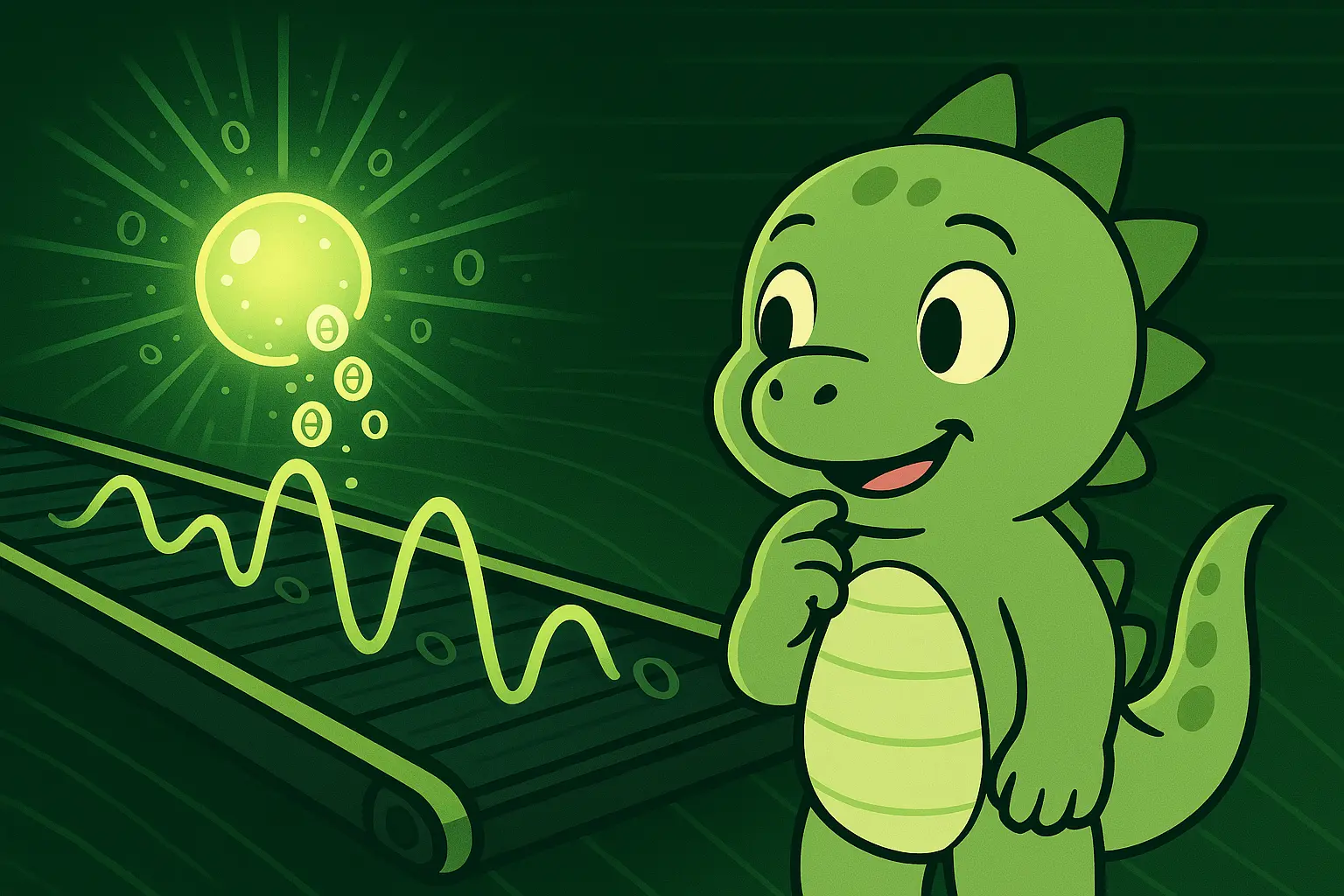
Imagine a conveyor belt. Someone at the top drops sand in a regular rhythm – that’s ? of the source.
But what you see on the belt... depends on the speed of the belt itself.
And that speed is not objective. It’s the ratio between the rhythm of the observer and the source.
If the belt moves "faster", grains are spaced out. If "slower", they pile up.
But the belt... is a result of the difference between ?? and ??. It’s not our time, nor the source’s time. It’s the transfer ratio between them.
Explaining rhythm difference
The source (e.g., a star) emits signals in its own time rhythm \( \Theta_s \). We measure it in our rhythm \( \Theta_p \), which corresponds to our local spacetime. What we observe as wavelength or frequency is a projection of one rhythm into another.
The difference between these two rhythms determines the "image" we get. If they differ, a shift occurs – waves stretch or compress. This doesn’t happen suddenly. It’s a smooth process, just like when a conveyor speed changes. How precisely we perceive it depends on our system’s resolution – whether it’s senses, an instrument, or even ADC bit depth on a microcontroller. ??
Example 1: Same rhythm
If light originates in an area with \( \Theta = 0.5 \), travels through free space \( \Theta \approx 1 \), and reaches the observer with \( \Theta = 0.5 \), the result is 1:1.
Waves stretch along the path but compress again upon return – the difference cancels out. This shows we don’t care what the wave meets on the way, only the rhythm of the source and the observer.
Example 2: True ?? difference
If light leaves a region with \( \Theta = 0.4 \), travels through space (\( \Theta \approx 1 \)) and hits an observer with \( \Theta = 0.6 \), then ?? = 0.6 - 0.4 = +0.2. The wave stretches – redshift.
If light passes near another object with temporarily lower ? (e.g. 0.3), the wave stretches more there. But the total observation depends only on ? at the start and end.
Microlensing
Temporary ? slowing along the path may affect intensity or direction – that’s the principle of gravitational lensing. We call it microlensing. The wave’s color doesn’t change, but it may be amplified or deflected.
Mathematical form
The observed frequency \( f \) is given by:
\[ f_{observer} = f_{source} \cdot \frac{\Theta_{source}}{\Theta_{observer}} \]
– if \( \Theta_{observer} < \Theta_{source} \): blueshift
– if \( \Theta_{observer} > \Theta_{source} \): redshift
Conclusion
Waves are not absolute. They are the result of rhythm relations. What we perceive depends only on the ? the light carries – and the ? we receive it with. And that opens the door to understanding ?? as the real foundation of all we see.