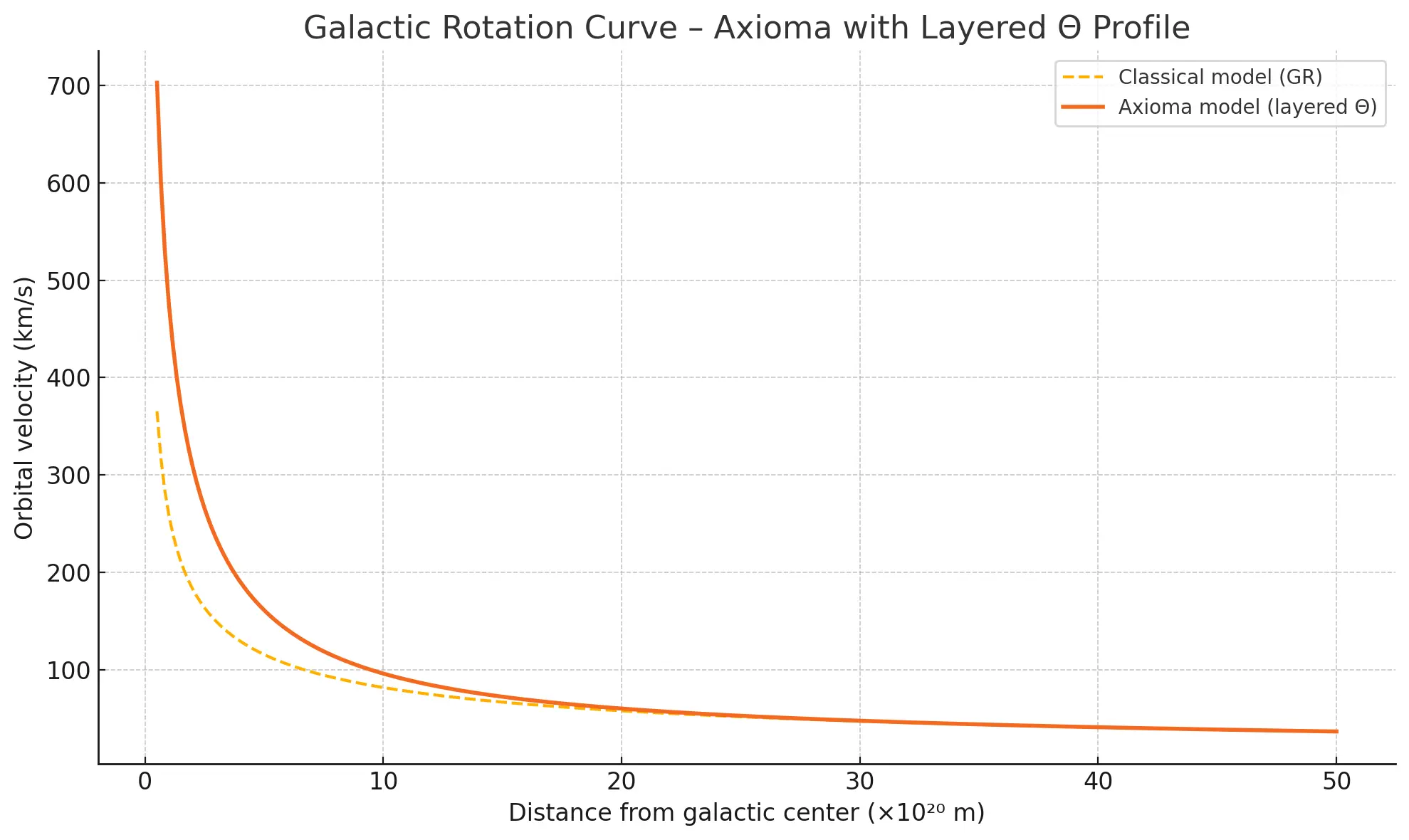
Chapter 5: Rotational Rhythm of Galaxies
Introductory Dialogue
Jakub: Axik, why do stars at the edge of galaxies move so fast? Shouldn’t they have flown off by now?
Axik: That’s a question people have asked for decades. But the answer isn't in matter – it's in time.
Jakub: In time? You mean they have a different ??
Axik: Exactly. And more than that – those with lower ? act like anchors. They carry greater rhythmic weight and pull the faster ones. The arms aren’t bound by gravity – they are bound by rhythm.
The Classical Physics Problem
In Newtonian or GR frameworks, stars at galactic edges should rotate more slowly. Yet they rotate too fast. This led to the concept of dark matter—supposedly generating unseen gravitational pull.
Axioma approaches it differently. No hidden forces—just differences in rhythm.
? as the Key to Rotation
Each location in the galaxy has a different ? – a different time rhythm. Stars closer to the center have lower ? due to greater gravitational distortion of time. Outer stars have higher ?.
This has two effects:
- Velocity: movement in our time looks different than in their own – ?? distorts perceived speed.
- Mass: effective gravitational impact increases as ? decreases – inner stars carry greater rhythmic mass.
Thus, even a small star in the center can “pull” the entire arm, and outer stars behave as if held by stronger gravity.
Axiomatic Model of Rotation
From classical physics:
\[ v^2 = \frac{G M}{r} \]
In Axioma, we define effective mass:
\[ m_{\text{eff}}(r) = \frac{m_0}{\Theta(r)} \quad \Rightarrow \quad M_{\text{axioma}} = \sum \frac{m_i}{\Theta_i} \]
The lower the ?, the stronger the impact. And the final rotation curve becomes:
\[ v^2 = \frac{G}{r} \sum \left( \frac{m_i}{\Theta_i} \right) \]
Not a gram of dark matter – just rhythm differences.
Spiral Arms as Temporal Nodes
Spiral structure isn’t random. Stars cluster where their ? aligns – where ?? is minimal. These are temporal nodes, where stars temporarily share rhythm. And that’s why spiral arms persist.
It's not mechanical stability. It’s rhythmic resonance in the ?-field.