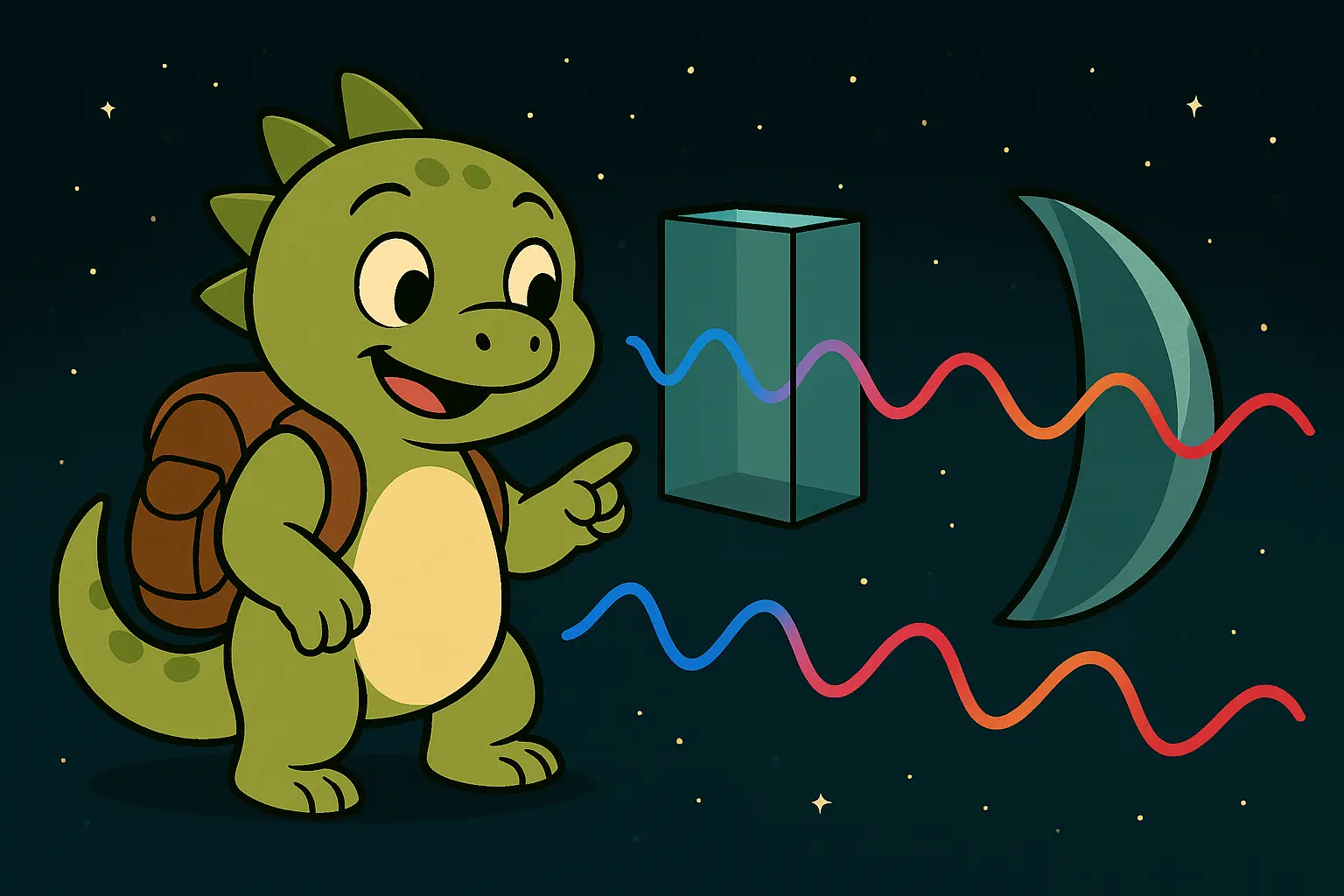
Chapter 4: Optical Phenomena
Axik takes a look around
Axik: So when light slows down in glass, it doesn't really slow down? ??
Jakub: Not exactly. It doesn't slow like a car braking. Its rhythm adjusts to the medium. Like tuning a radio. It doesn't lose speed—it shifts frequency.
?? Refraction and slowing of light in glass
Classical physics says: light slows down in glass because n = c / v. But Axioma says:
The speed doesn't change. The rhythm does.
As a photon passes through glass, it retunes—its rhythm adapts to the ?-landscape of the material. This phase slip appears to us as slowing or refraction.
\[ n_{\text{axioma}} = \frac{\Theta_{\text{medium}}}{\Theta_{\text{vacuum}}} \]
When \( \Delta \Theta \approx 0 \), the photon passes through effortlessly. Otherwise, it scatters or detunes like a radio out of range.
?? Gravitational lenses and optical systems
In classical physics: light bends because mass warps spacetime.
In Axioma: light bends because it follows a ?-gradient. A photon is nothing but a rhythmic node, seeking the shortest natural path in the rhythm field.
\[ \delta \phi \propto \int \left| \frac{d\Theta}{dr} \right| dr \]
So instead of bending trajectory, we say: a shift in rhythmic direction.
? Rhythmic transmission and slingshot effect
Sometimes photons emerge earlier than expected. Or are accelerated unexpectedly. Classical physics calls it tunneling or gravitational slingshot. But Axioma says:
If the photon's ? perfectly matches the environment, there's no rhythmic resistance. The wave locks in. The photon doesn't delay—it passes cleanly. This is an axiomatic resonance transmission.
If the environment is changing rapidly, and ? shifts dramatically—say when a photon brushes an atomic nucleus—a strong ?-gradient can cause acceleration, retuning, or deflection. Like a comet flung by a gravity assist—but done through rhythm.
\[ \text{Resonance:} \quad \Delta \Theta \rightarrow 0 \quad \Rightarrow \quad T \rightarrow 1 \] \[ \text{Slingshot:} \quad \frac{d\phi}{dt} \propto -\frac{d\Theta}{dr} \]
These aren't exceptions—they're consequences of the rhythmic structure of space. Waves don't propagate absolutely. They travel in rhythm.
?? Inverse proof of the photon's axiomatic mass
If we know:
- the shape and mass of the lens
- the bending angle after light passes through
We can reverse calculate how much the photon's rhythm had to adjust—giving us its "axiomatic mass":
\[ m_{\text{axioma}} \propto \left| \frac{d\Theta}{dr} \right| \]
This doesn't tell us how much it weighs. It tells us how easily it bends rhythmically. The higher the number, the more it conforms to its surroundings.